
The short answer
When should increased thirst and urination be investigated?
Contact your usual veterinary practice if your dog is consistently drinking more, emptying the bowl unusually quickly, asking to go outside more often, passing larger volumes of urine or having new accidents indoors. A persistent change deserves assessment even when your dog still seems bright.
Veterinary teams may describe these signs as polydipsia, meaning increased thirst, and polyuria, meaning increased urine production. They are signs rather than a diagnosis. Do not restrict your dog’s water while the cause is being investigated.
Is your dog producing more urine, urinating more often or leaking?
These patterns can look similar at home but may point towards different parts of the urinary or internal-medicine work-up. Describe what you see rather than trying to choose the diagnosis yourself.
- Increased urine volume
- Larger puddles, a heavier puppy pad, longer urination or a much fuller overnight bladder. This is the pattern usually meant by polyuria.
- Increased frequency
- Many small attempts, urgency, straining, licking or discomfort may indicate irritation of the bladder or lower urinary tract rather than increased total urine production.
- Urinary incontinence
- Leaking without adopting a normal toileting posture, damp bedding or dribbling while resting or walking. It may occur with or without increased thirst.
- Behavioural or mobility change
- Anxiety, incomplete house training, cognitive change, pain or difficulty getting outdoors can also cause accidents, especially in older dogs.
Repeated straining with little or no urine is an emergency. Telephone a veterinary practice immediately rather than waiting to measure water intake or collect a sample.
How much water should a dog drink?
There is no single normal amount for every dog. Body size, activity, weather, pregnancy or lactation, diet and medication all affect water needs. A dog eating wet food may drink less from the bowl than a dog eating dry food, while warm weather and exercise can temporarily increase intake.
The most useful observation is often a clear change from your dog’s own normal pattern. If your vet asks for a 24-hour measurement, start with a known amount, record everything added to the bowls, measure what remains at the end and note other sources such as toilets, outdoor bowls or puddles. Measuring is much harder in a multi-pet home, so tell the practice if the total cannot be attributed to one dog.
Keep fresh water freely available throughout the measurement. Do not perform a water-deprivation test at home.
Why might a dog drink and urinate more?
Possible causes include kidney disease, diabetes mellitus, Cushing’s disease, liver disease, high blood calcium, urinary infection and an infected womb known as pyometra. Steroids, diuretics, some anti-seizure medicines and other medication can also change thirst or urine production.
Less common causes include disorders of water-balance hormones, certain cancers and primary excessive drinking. These are usually considered only after common medical and medication-related causes have been assessed. A short-lived increase after heat, exercise or a change from wet to dry food may be understandable, but a sustained or unexplained change should still be discussed with your vet.
Symptoms overlap. For example, diabetes may cause increased appetite and weight loss alongside thirst, while Cushing’s disease may be accompanied by panting, skin or coat change, muscle loss and a pot-bellied appearance. Kidney disease can be subtle initially. No single outward sign confirms the cause.
What should I record before the veterinary appointment?
A short, accurate record can help your vet choose the most useful first tests. Note:
- When the change began and whether it is stable, intermittent or worsening
- A 24-hour water measurement if the practice recommends one
- Whether urine volume is larger, trips outside are more frequent, or leaking occurs
- Appetite, weight, energy, vomiting, diarrhoea, panting and skin or coat changes
- Your dog’s full diet and any recent change between wet and dry food
- Every medication, supplement and recent injection, including steroids or diuretics
- For an unneutered female, the date of the last season and any vaginal discharge
- Possible access to toxins, human medication, salty foods or unusual water sources
Ask the practice whether they would like a fresh urine sample and how they want it collected, stored and delivered. Do not delay an urgent assessment while trying to obtain one.
What tests may happen first?
Your vet will review the history and medication, examine your dog, assess hydration and body condition, and look for findings that help prioritise the possible causes. Weight, temperature, abdominal palpation and sometimes blood pressure can provide useful context.
Urinalysis can assess urine concentration and look for glucose, ketones, protein, blood, inflammation and other changes. A urine culture may be recommended when infection is possible. Blood tests can assess glucose, kidney and liver values, electrolytes, calcium, blood cells and other indicators selected for the individual patient.
Results must be interpreted together. Dilute urine does not identify one disease by itself, and an abnormal blood result may need confirmation or further investigation. Not every dog needs every test on the first day.
When might further investigation be recommended?
A fuller work-up may be useful when first-line results are abnormal or contradictory, the signs persist despite an initial plan, kidney or endocrine disease is suspected, infection keeps returning, weight or appetite is changing, or several body systems appear to be involved.
Further steps might include repeat or specially collected urine testing, urine protein measurement, blood-pressure assessment, endocrine function tests, abdominal imaging and selected sampling. The sequence matters: hormone tests, for example, are most useful when the history and initial results make the relevant condition reasonably likely.
Available through veterinary referral
A coordinated renal, endocrine and abdominal work-up.
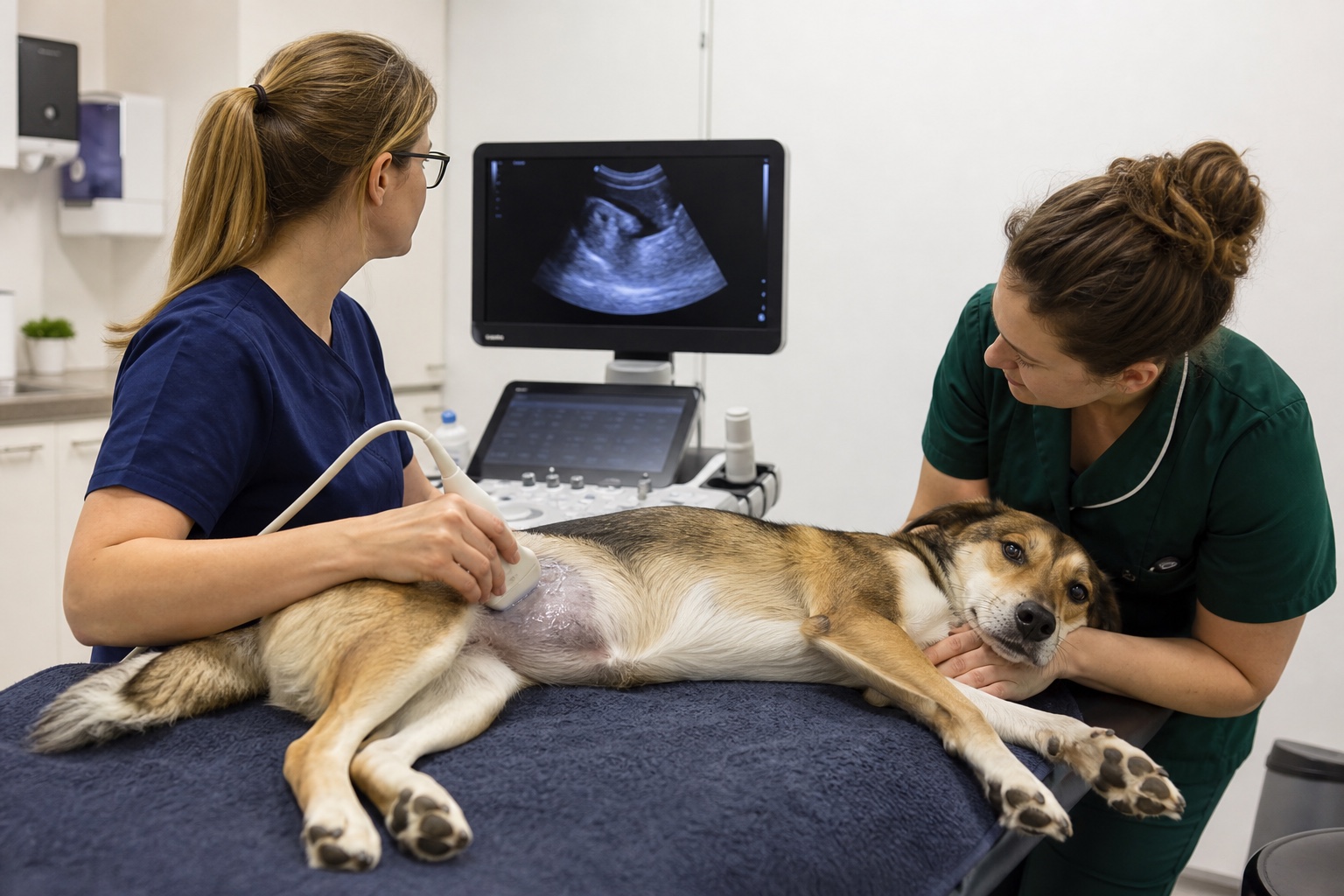
For suitable referred dogs, Fabrizio Tucciarone can provide a postgraduate-qualified internal-medicine assessment and coordinate abdominal ultrasonography and targeted sampling where those steps are likely to clarify the cause of increased thirst or urination.
The pathway begins with the clinical question and the results already obtained by the primary vet. Investigations are then prioritised around the individual patient so that each test has a clear purpose and the usual veterinary practice remains central to ongoing care.
Nephrology and urinary medicine
Clinical history, blood pressure, urine findings, kidney markers and imaging can be combined to assess suspected renal disease, protein loss, recurrent infection or other urinary concerns.
Endocrine and metabolic investigation
When diabetes, Cushing’s disease, Addison’s disease, calcium disturbance or another hormonal problem is suspected, tests can be staged according to the clinical pattern and first-line results.
Abdominal ultrasonography and sampling
Ultrasound can assess relevant abdominal structures and guide selected sampling where appropriate. It complements rather than replaces laboratory testing and clinical interpretation.
Does every dog need an abdominal ultrasound?
No. Many dogs begin with examination, urine testing and blood tests because these may identify the cause or show which imaging question needs to be answered. Ultrasound becomes more useful when organ structure, an abdominal mass, stones, obstruction, adrenal change, pyometra or another structural problem is a realistic concern.
Ultrasound cannot diagnose every hormonal disease and a normal scan does not exclude all medical causes of increased thirst. The most useful plan combines imaging with the history, examination and laboratory results.
Is drinking more simply part of getting older?
No. Older dogs are more likely to develop some conditions that increase thirst and urination, but the change itself should not be accepted as normal ageing. Early assessment may identify a manageable disorder before the dog becomes obviously unwell.
New accidents in an older dog may also involve incontinence, pain, reduced mobility or cognitive change. Tell your vet whether the dog passes large amounts consciously, asks to go out more often, leaks while asleep or appears confused about toileting.
Common questions
Dog drinking and urinating more FAQs
When should I contact my vet if my dog is drinking and urinating more?
Contact your usual veterinary practice whenever there is a persistent or unexplained increase in drinking or urine production, even if your dog otherwise seems well. Seek urgent help if your dog is weak, vomiting repeatedly, unable to keep water down, struggling to pass urine, collapses, or is an unneutered female with possible signs of pyometra.
How much water is too much for a dog?
There is no single amount that is normal for every dog. Body size, diet, weather, exercise, medication and health all affect water intake. A clear change from your dog’s usual pattern is important. If your vet asks you to measure intake, record all water added and remaining over a complete 24-hour period and tell them about any other water sources.
Should I restrict my dog’s water if they are drinking too much?
No. Never restrict access to fresh water unless a veterinarian gives you a specific, closely supervised instruction. A dog may be drinking to replace water lost through increased urination, and removing water can cause dangerous dehydration or electrolyte disturbance.
Why has my dog started urinating in the house?
House-soiling can occur when a dog produces more urine and cannot wait as long between toilet breaks. It can also result from urinary infection, bladder irritation, incontinence, pain, mobility difficulty, behavioural factors or cognitive change. The pattern and a urine test can help your vet distinguish these possibilities.
What tests may be recommended for increased thirst and urination?
The starting point commonly includes a clinical history, examination, urinalysis and blood tests. Depending on the findings, your vet may recommend urine culture, blood pressure measurement, urine protein assessment, endocrine testing, abdominal imaging or other targeted investigations. Tests should be selected for the individual dog rather than performed as a fixed panel.
Could increased thirst and urination mean my dog has diabetes?
Diabetes mellitus is one possible cause, particularly when increased thirst and urination occur with weight loss despite a normal or increased appetite. However, kidney disease, hormonal disease, liver disease, infection, medication and several other problems can produce similar signs. Blood and urine tests are needed to identify the cause.
Can I book an investigation directly with Mobile Vet Referral?
No. Pet owners should contact their usual veterinary practice first. If a fuller internal-medicine, renal, endocrine or ultrasound investigation is appropriate, the primary vet can arrange referral and provide the clinical history and previous results.