
The short answer
When should a dog’s cough be investigated?
Contact your usual veterinary practice if your dog has been coughing regularly for more than a few days, if the cough keeps returning, or if your dog seems unwell. Arrange advice sooner if the cough is accompanied by reduced appetite, lethargy, fever, weight loss, exercise intolerance, noisy breathing or collapse.
A cough is a symptom rather than a diagnosis. It may originate in the throat, windpipe, bronchi, lungs or cardiovascular system, and dogs can occasionally have more than one contributing condition.
Is it a cough, gagging or reverse sneezing?
These events can sound similar, particularly when a cough ends with a gag. A video recorded safely at home is often more useful than trying to imitate the sound during the appointment.
- Cough
- A sudden forceful expulsion of air. It may sound dry, harsh, honking or moist and can finish with swallowing or a gag.
- Gagging or retching
- Repeated swallowing or abdominal effort as though trying to bring something up. Nausea, throat irritation and coughing can all trigger it.
- Reverse sneezing
- Repeated rapid, noisy inhalations through the nose, often with the neck extended. It is different from a cough but still deserves advice if frequent, prolonged or accompanied by other signs.
- Sneezing
- A sudden expulsion of air through the nose, sometimes with nasal discharge. Sneezing generally points towards the nasal passages rather than the lower airways.
If you are unsure what you are seeing, describe the whole episode and show your veterinary team the recording. Do not delay urgent care to obtain a video.
Why might a dog keep coughing?
Possible causes include infectious respiratory disease, inflammation of the airways, tracheal or bronchial collapse, inhaled plant material or another foreign body, aspiration, pneumonia, lungworm or other parasites, and diseases affecting the lung tissue. Masses and cardiovascular disease are also possible causes in some dogs.
Age, breed, travel, vaccination history, exposure to other dogs, the timing of the cough and findings on examination all influence which causes are most likely. A diagnosis should not be made from the sound of the cough alone.
What should I record before seeing my vet?
A focused history can help your veterinary team decide which tests are most useful. Note:
- When the cough began, how often it happens and whether it is worsening
- Whether it sounds dry, harsh, honking, moist or ends with gagging
- Triggers such as excitement, exercise, drinking, eating, lead pressure or lying down
- Breathing effort, sleeping comfort and exercise tolerance
- Fever, nasal discharge, reduced appetite, weight loss, weakness or collapse
- Recent boarding, daycare, travel or contact with coughing dogs
- Vaccination, lungworm prevention, medication and relevant previous illness
- Exposure to smoke, aerosols, dust, grass seeds or possible inhaled material
If infectious respiratory disease is possible, telephone the practice before arriving so the team can reduce exposure to other patients.
What may happen at the first veterinary appointment?
Your vet will review the history, watch any videos, assess your dog’s breathing and circulation, examine the mouth and throat where appropriate, and listen to the heart and lungs. The findings help determine whether the problem appears most consistent with an upper airway, lower airway, lung or cardiovascular disorder.
Depending on the clinical picture, initial investigations may include blood tests, parasite testing and chest radiographs. Cardiac biomarkers, an ECG or an echocardiogram may be considered when the heart could be involved. Not every dog needs advanced investigation immediately.
Does coughing always mean heart disease?
No. Heart disease is one possible cause, but infection, airway inflammation, collapsing airways, foreign material, parasites and lung disease can produce similar signs. A heart murmur does not prove that a cough is cardiac, and an older dog may have both cardiac and respiratory disease.
Chest radiographs help assess the lungs, airways, heart silhouette and blood vessels. Echocardiography evaluates the structure and function of the heart. These tests answer different questions and may be used together when the clinical findings are not clear.
Available through veterinary referral
A staged cardiopulmonary work-up for persistent coughing.
For suitable referred dogs, Fabrizio Tucciarone can combine advanced internal medicine assessment with echocardiography, thoracic ultrasonography and bronchoscopy when those investigations are likely to clarify the cause of a persistent cough.
The pathway starts with the clinical question and the results already obtained by the primary vet. Tests are selected in a logical sequence according to the patient’s stability, the suspected location of disease and whether the result is likely to change treatment or prognosis.
Internal medicine and respiratory assessment
A structured review of the cough, examination, previous treatment, laboratory results and imaging helps prioritise infectious, inflammatory, structural, parasitic, pulmonary and systemic causes.
Explore internal medicineEchocardiography and thoracic ultrasonography
Echocardiography assesses cardiac structure and function when heart disease is a concern. Thoracic ultrasonography can provide additional information about suitable peripheral lung, pleural or mediastinal abnormalities, but it does not replace chest radiographs.
Explore ultrasonographyBronchoscopy and airway sampling
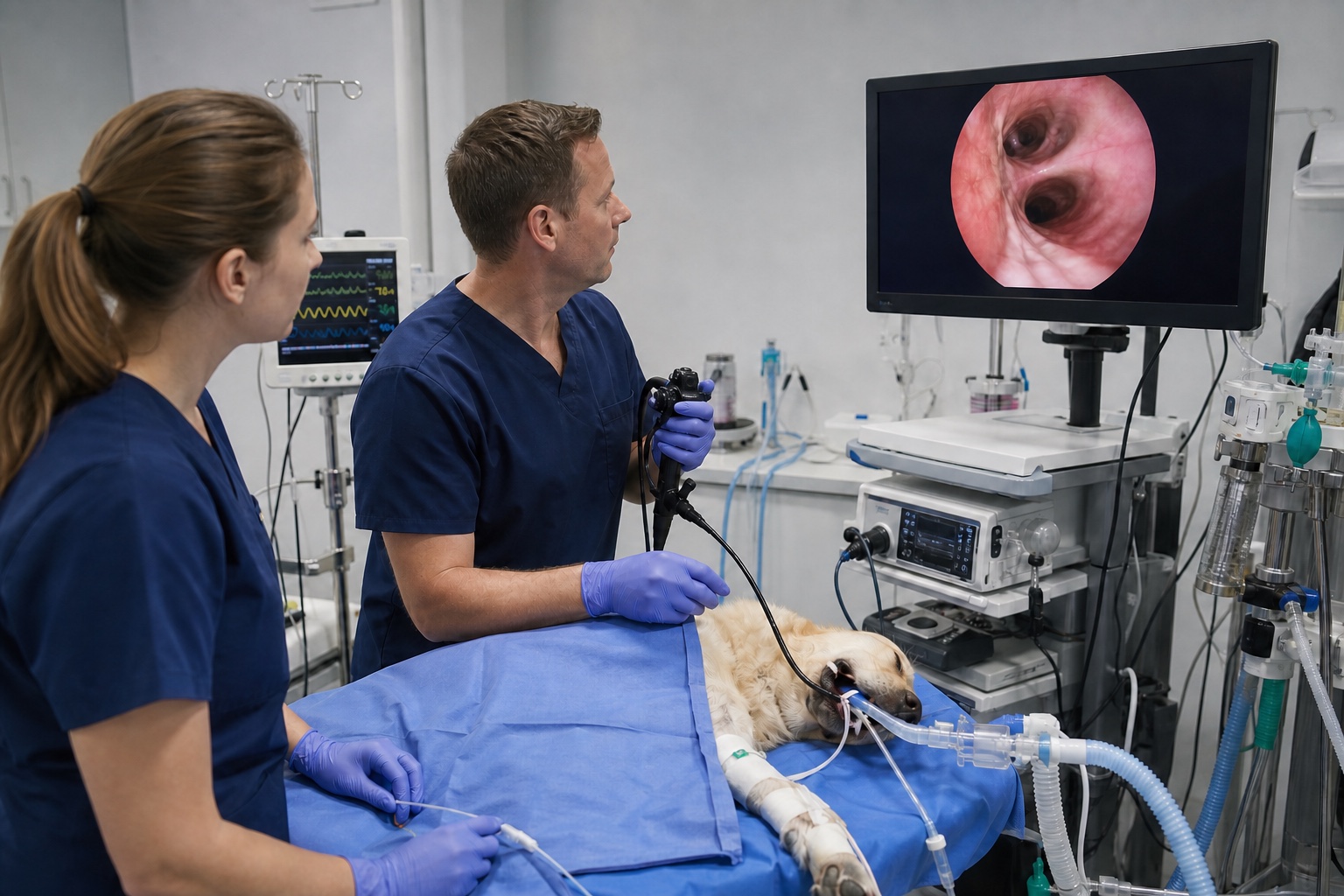
Bronchoscopy can identify mucus, foreign material, airway inflammation, structural change or dynamic collapse. Bronchoalveolar lavage, brush cytology or culture may add information when sampling is clinically appropriate.
Explore endoscopyWhen might bronchoscopy be useful?
Bronchoscopy may be considered when coughing persists despite an appropriate initial plan, when imaging suggests airway disease, or when direct visualisation and samples are likely to change management. It is performed under general anaesthesia, so the expected diagnostic benefit and the individual anaesthetic risk should be reviewed beforehand.
The bronchoscope can examine the trachea and accessible bronchi for mucus, inflammation, foreign material, narrowing or collapse. Sterile fluid can be introduced and retrieved from selected airways for cytology and, where indicated, culture. Sampling should be planned around the clinical question, because no single sample identifies every respiratory disorder.
Does a coughing dog need antibiotics or cough medicine?
Not automatically. Treatment depends on the underlying cause and may involve rest, environmental changes, parasite treatment, anti-inflammatory medication, bronchodilators, cardiac treatment, removal of foreign material or another targeted plan. Antibiotics are useful only for selected infections and should not be given simply because a dog is coughing.
Do not give leftover veterinary medication or human cough, cold or pain medicines unless your vet has specifically advised them for your dog. Suppressing a productive cough can be inappropriate in some respiratory conditions.
Common questions
Dog coughing FAQs
When should I contact my vet about my dog’s cough?
Contact your veterinary practice if the cough happens regularly, continues for more than a few days, keeps returning, disturbs sleep or exercise, or occurs with lethargy, reduced appetite, weight loss or collapse. Seek immediate veterinary help if your dog is struggling to breathe, has pale, blue or grey gums, coughs up blood, collapses or may have something lodged in the airway.
How can I tell whether my dog is coughing or gagging?
A cough is usually a sudden forceful expulsion of air and may sound dry, harsh, honking or moist. Gagging or retching often involves repeated swallowing, abdominal effort or an attempt to bring something up. Reverse sneezing sounds like rapid, forceful inhalations through the nose. These can overlap, so record a video and let your vet assess it rather than relying on the sound alone.
Does coughing in a dog always mean heart disease?
No. Coughing can arise from the throat, windpipe, bronchi, lungs or cardiovascular system. Infection, airway inflammation, airway collapse, inhaled material, parasites and lung disease are among the other possibilities. Some dogs can have more than one condition, so the examination and appropriate tests matter.
What tests may be recommended for a dog that keeps coughing?
The plan depends on the dog and may include blood tests, parasite testing, chest radiographs, cardiac assessment or echocardiography, and sometimes advanced imaging, bronchoscopy or airway sampling. Not every dog needs every test, and investigations are usually staged around the most likely causes and the patient’s stability.
What does bronchoscopy involve?
Bronchoscopy uses a flexible camera to examine the trachea and bronchi while the dog is under general anaesthesia. It can reveal mucus, airway inflammation, foreign material, structural change or dynamic airway collapse, and it allows targeted samples such as bronchoalveolar lavage fluid to be collected when appropriate.
Can I book a cough investigation directly with Mobile Vet Referral?
No. Pet owners should contact their usual veterinary practice first. If further investigation is appropriate, the primary vet can arrange referral and provide the clinical history, previous results, imaging and treatment response.
Sources and further reading
- PDSA: Coughing in dogs
- MSD Veterinary Manual: Introduction to lung and airway disorders of dogs
- MSD Veterinary Manual: Clinical signs of respiratory disease
- Veterinary Clinics of North America: The approach to chronic cough in dogs and cats
- Journal of Veterinary Internal Medicine: Bronchoscopic sampling in dogs and cats with chronic cough